
This post contains affiliate links. We may earn a commission if you purchase through a link at no extra cost to you. This article was researched and drafted with AI assistance and reviewed by a human editor before publication.
Not sure which type of setup fits your home? Try our 5-question Cold Plunge Finder first — it checks floor, frequency, budget, renting and power before any brand.
The tub you can buy and the tub you can actually install are not always the same thing. Most of the regret in this category is not about the product — it is about a $9,000 delivery arriving at a house with a 30-inch doorway, or a filled tub sitting on a deck that was never designed to hold it.
Work through this before you order. It takes twenty minutes and it is the difference between a good purchase and an expensive mistake.
Start Here: What Your Filled Tub Weighs
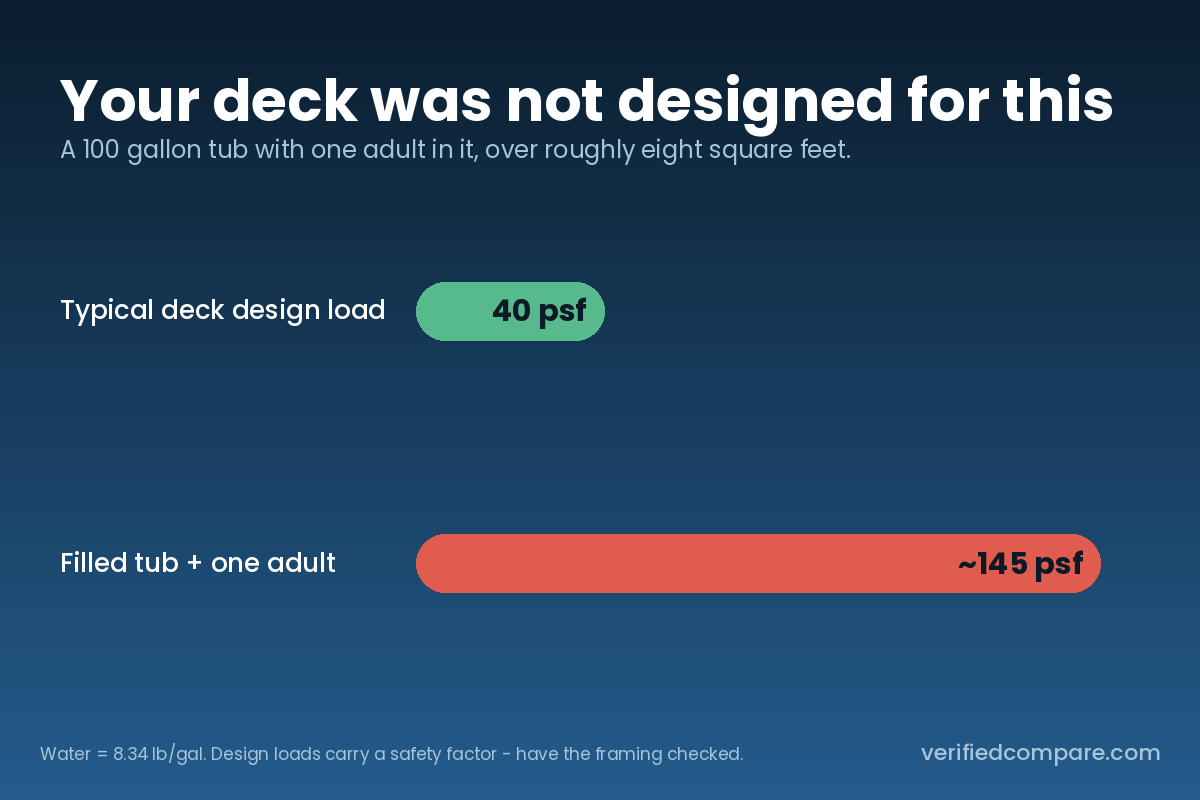
This is the number almost nobody checks, and it is the one most likely to cause real damage. Water weighs 8.34 lb per US gallon. Add the tub, add yourself.
| Capacity | Water | Plus tub (approx.) | Plus one adult | Total on the floor |
|---|---|---|---|---|
| 25 gal inflatable | 209 lb | +25 lb | +180 lb | ~414 lb |
| 85 gal barrel | 709 lb | +100 lb | +180 lb | ~989 lb |
| 100 gal rigid tub | 834 lb | +150 lb | +180 lb | ~1,164 lb |
| 150 gal premium plunge | 1,251 lb | +300 lb | +180 lb | ~1,731 lb |
Why this matters on a deck. Residential decks in the US are commonly built to a 40 lb per square foot live load. A 100 gallon tub occupying roughly eight square feet puts about 145 lb per square foot on that area — more than three times the design load, concentrated rather than spread.
That does not automatically mean your deck will fail, because design loads carry a safety factor and load spreads through the joists. It does mean this is a question for someone who can look at the framing, not something to decide from a product page. Ground level, a concrete pad, or a slab is the easy answer.
The Pre-Order Checklist
Every one of these has caught someone out.
- Measure the route in, not just the room. Doorways, stair turns, gate width, and any tight corner. Premium tubs are commonly 30 to 40 inches wide and do not flex. Check the crated dimensions, which are larger than the tub.
- Confirm the delivery method. Kerbside delivery means the pallet is left at the end of your drive and the rest is your problem. White glove costs more and is worth it above about 300 lb.
- Find the nearest outlet and know its circuit. See the power section below.
- Decide now where 100 gallons of water goes when you drain it. Not “the garden” — which part of the garden, and does the hose reach.
- Check clearance around the chiller. Most need six to twelve inches of free air on the vented sides. Pushed against a wall, it works harder, runs longer and costs more.
- Check the surface is level. An unlevel tub loads one side of the shell and, on a chiller unit, can affect how the pump primes.
- Call the building office if it is going outdoors and staying there. Some municipalities treat a permanent plunge like a hot tub for permitting and barrier requirements.
Power
Chillers draw continuous power rather than in bursts, which is what catches out shared circuits. A chiller on the same circuit as a garage freezer and a power tool will trip the breaker eventually, usually in August when the chiller is working hardest.
- A dedicated 20-amp circuit is the safe default for any built-in chiller. Check the manufacturer’s stated draw — they vary.
- GFCI protection is not optional. Water and mains electricity in the same place. If the outlet is not GFCI protected, that is an electrician job before delivery, not after.
- Extension leads are a bad idea for a continuous load. If the outlet is not where you need it, move the outlet.
- Portable chillers usually use a standard wall plug, but check the circuit requirement. Sun Home’s portable plunges, for example, specify a dedicated 15 amp GFCI circuit. In a rental that can be the deciding question — see cold plunge for renters.
This is general guidance, not an electrical specification. Requirements vary by country and by unit, and an electrician looking at your actual panel is cheap compared to the tub.
By Location
| Where | What suits it | The thing people miss |
|---|---|---|
| Apartment | Inflatable, or portable chiller unit | Drainage route and a catch tray |
| Garage | Any chiller-equipped tub | Dedicated 20-amp circuit; chiller heat |
| Basement | Chiller-equipped, mid size | Floor drain and humidity |
| Patio or slab | Anything, including large tubs | Level surface; permitting |
| Raised deck | Smaller tubs only, after checking framing | Load rating — see above |
Apartment
An inflatable with a portable chiller is the realistic option, and it works. If you rent, read our cold plunge for renters guide first — the lease and the circuit matter as much as the tub. Put a large catch tray down before the first fill, not after the first spill — the water will get out at some point, and a ground-floor neighbour is an expensive way to learn that.
Draining is the recurring problem. Work out the route to a bath, a shower or a balcony drain before you buy, and buy a hose long enough to reach with slack. A submersible pump costs under $50 and turns a forty-minute job into a five-minute one.
Garage
The best location for most people: concrete floor, drainage is usually solvable, and nobody minds the noise. Two things to plan for. The chiller puts out heat — it moves warmth from the water into the room, so a closed garage in summer gets warmer and the chiller then has to work harder against its own output. Ventilation helps. And it makes noise, roughly comparable to a fridge but running longer, which matters if the garage shares a wall with a bedroom.
Basement
Good for temperature stability — a cool basement is the cheapest place to run a chiller. Watch humidity: an open tub of water evaporates continuously into a space with limited air exchange, and a dehumidifier may end up being part of the setup. A floor drain turns water changes from a chore into a tap turn.
Patio, Slab or Ground Level
The simplest case. Level ground, no load question, drainage is wherever you point the hose. If it is staying permanently, call the local building office before the tub arrives — some treat a fixed plunge like a hot tub, including barrier and fencing requirements. That call is five minutes and occasionally saves a rebuild.
Winter, If It Lives Outside
A chiller keeps water cold; it does not keep it from freezing solid, and a frozen circulation line will crack. Most manufacturers specify a minimum ambient operating temperature, and below it you are expected to drain and winterise. Find that number before you buy if you are somewhere that gets hard frosts.
An uninsulated ice bath outdoors in winter has the opposite problem, which is a nice one to have: the ambient air does the chilling for you and the ice bill falls to nothing for a few months.
Which Setup Should You Choose?
- Renting, upstairs, no outdoor space: inflatable with a portable chiller, on a catch tray, with a submersible pump for draining.
- Garage with a spare wall: any chiller-equipped tub, on a dedicated 20-amp GFCI circuit, with clearance around the vents.
- Ground-level patio or slab: anything you like. Check permitting if it is permanent.
- Raised deck: do not order until someone has looked at the framing. Then buy small.
- Basement: mid-size chiller tub, ideally near a floor drain, and budget for a dehumidifier.
FAQ
Do I need a floor drain?
Not required, but it changes water changes from a twenty-minute job into a two-minute one. If you do not have one, buy a submersible pump.
Can I put a cold plunge on a wooden deck?
Sometimes, but not on the basis of a product page. A filled 100 gallon tub with someone in it is over 1,100 lb concentrated on a few square feet, against a typical residential deck design load of 40 lb per square foot. Get the framing looked at, or site it at ground level.
Does a cold plunge need a permit?
It varies by municipality. Permanent outdoor installations are the ones most likely to be treated like a hot tub, including barrier requirements. One phone call answers it.
How loud is the chiller?
Broadly comparable to a refrigerator, but it cycles for longer periods. Fine in a garage; consider carefully against a bedroom wall.
Will the chiller heat my garage?
Yes, slightly. It moves heat out of the water and into the room. In a small closed garage in summer that becomes a feedback loop and the chiller runs longer. Ventilation is worth arranging.
How often do I change the water?
With filtration and ozone or UV, a few weeks. Without any filtration, every few sessions. This is the single biggest practical difference between the tiers.
What about hard freezes?
Check the manufacturer’s minimum ambient temperature. Below it, drain and winterise — a frozen line will crack and that is not a warranty claim.
Ready to Choose One?
This page is about whether a tub can live where you want it. Once that is settled, the model comparison is the next step.
Best Cold Plunge Tubs for Home Use (2026) — ten models compared, with the chiller, water care and warranty split laid out.
8 Cold Plunge Brands Compared — who each brand is actually aimed at, including the ones that pay us nothing.
Save This for Later

Related Guides
- Cold Plunge for Renters — lease, floor load, power, and a landlord email
- Best Cold Plunge Tubs for Home Use (2026) — model by model
- Budget Cold Plunge Tubs Under $1,000 — and the ice arithmetic
- Cold Plunge vs Ice Bath — chiller or ice
- 8 Cold Plunge Brands Compared — who each brand suits
- Best Home Saunas (2026) — infrared vs traditional, and the electrical question
- Sauna or Cold Plunge: Which Should You Buy First? — buy what your climate cannot give you free
- Sun Home Nova Review — the new traditional sauna, specs confirmed with Sun Home
- Sun Home Promo Code — $200 off, what qualifies