
This post contains affiliate links. We may earn a commission if you purchase through a link at no extra cost to you. This article was researched and drafted with AI assistance and reviewed by a human editor before publication.
Not sure which type of setup fits your home? Try our 5-question Cold Plunge Finder first — it checks floor, frequency, budget, renting and power before any brand.
Not everyone needs a $14,000 chiller-equipped tub to get the benefits of cold exposure. If you want to find out whether cold plunging is for you before committing, everything on this page gets you into genuinely cold water for under $1,000.
There is a catch, and it is the whole story of this price tier: none of these chill the water. You bring the cold, in bags, every session. Before you buy anything here, read the ice arithmetic below — for a lot of people it changes the decision entirely.
The Ice Maths Nobody Puts on the Product Page
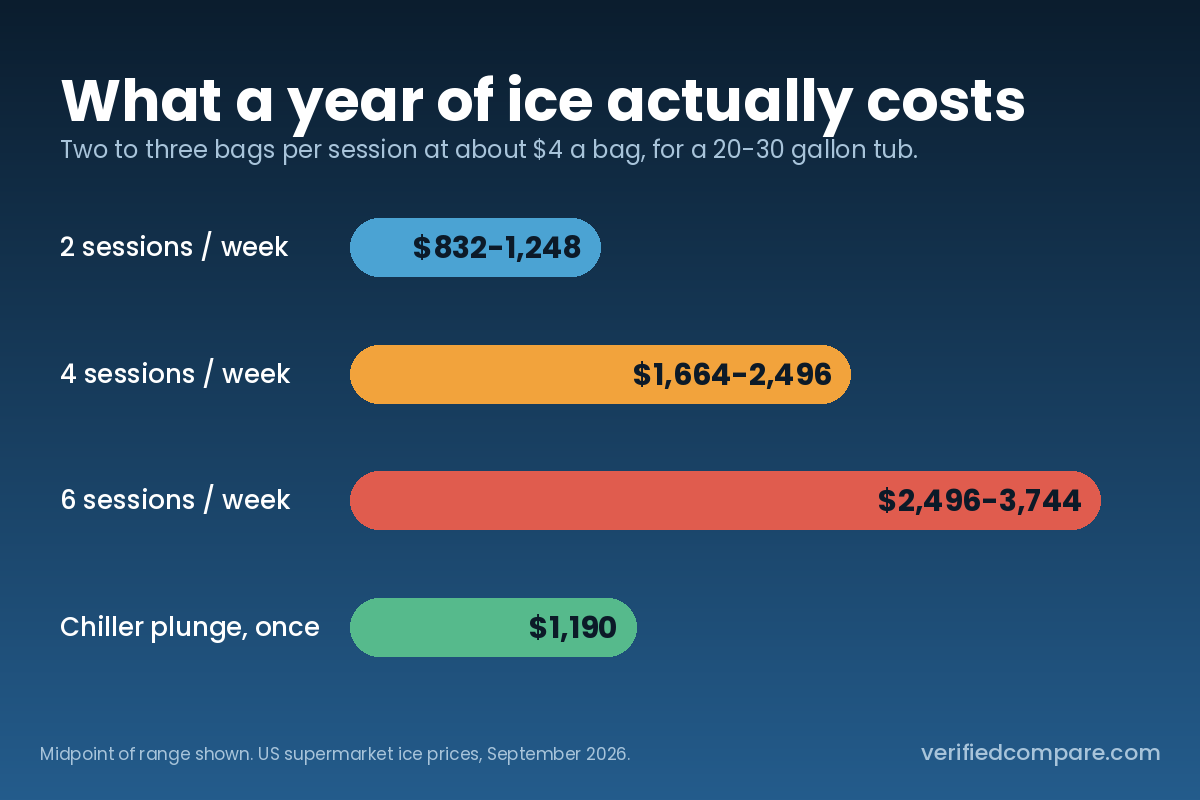
A 20 to 30 gallon tub takes roughly two to three bags of ice to bring down to plunge temperature, and you do it again every session. At around $4 a bag in most US supermarkets, that is $8 to $12 per plunge.
| Sessions per week | Ice per week | Ice per year |
|---|---|---|
| 2 | $16–$24 | $832–$1,248 |
| 4 | $32–$48 | $1,664–$2,496 |
| 6 | $48–$72 | $2,496–$3,744 |
At four sessions a week, a year of ice costs more than a $1,190 inflatable plunge with a built-in chiller. That is the single most useful number on this page and almost nobody writing about budget tubs mentions it.
If that number already decided it for you, the cheapest chiller-equipped tub from a brand we have vetted is Sun Home’s entry model at $3,999 — check current pricing. If it did not, keep reading: the budget tier is genuinely the right answer for a lot of people.
Which does not make the budget tier pointless. It makes it a trial, not a destination. Buy at this price to find out whether you will actually do this four times a week in February. If the answer turns out to be yes, the ice bill will push you upmarket on its own.
How We Picked
We have not used these tubs. We do not own them, and we are not going to describe how the water felt. What we did instead was compare published specifications against independent reviews and owner reports, and flag where they disagree.
This tier is also unusual in that most of it is unbranded. The same rigid tubs and double-wall inflatables appear under a dozen different names, often with the same moulding and different stickers. So we are comparing categories of product rather than naming models we cannot verify are distinct. Where a brand is named below, it is because the product is genuinely its own.
We judged on four things: insulation (how long it holds cold once you have paid for the ice), capacity against footprint, durability over a full outdoor year, and whether it packs away.
Comparison Table
| Type | Price | Cooling | Capacity | Packs away | Best for |
|---|---|---|---|---|---|
| Basic single-wall inflatable | $150–$400 | Manual ice | 20–30 gal | Yes | Lowest possible upfront cost |
| Double-wall insulated inflatable | $300–$600 | Manual ice | 25–40 gal | Yes | Apartments and shared spaces |
| Rigid stock-tank style | $300–$700 | Manual ice | 40–100 gal | No | Backyard, year-round outdoors |
| Insulated barrel (Ice Barrel and similar) | ~$1,150* | Manual ice | ~85 gal | No | Upright plunging, small footprint |
| Inflatable with chiller | from $1,190 | Ice-free to 35°F | Varies | Yes | Anyone plunging 3+ times a week |
*The Ice Barrel sits just above the $1,000 line and is included as the reference point the whole category is measured against. Prices are as published in September 2026.
Our Picks
Best for Apartments — Double-Wall Insulated Inflatable
These fold flat between uses, which is the only thing that matters if the tub has to live in a cupboard. Insulation quality varies enormously across this category: a thick double-wall inflatable holds cold for hours where a single-wall one is lukewarm before you have finished.
Good: packs away; light enough to carry filled-empty; no installation, no drainage plan, no landlord conversation.
Less good: punctures are a real risk and most come with a patch kit for a reason; the walls flex when you get in, which some people find unpleasant; UV degrades the material if you leave it outside all summer.
Best for a Permanent Backyard Setup — Rigid Stock-Tank Style
More durable than an inflatable and usually cheaper per gallon. Galvanised or hard plastic, no moving parts, survives a winter outdoors without complaint.
Good: most capacity for the money; genuinely lasts years outdoors; you can sit rather than crouch.
Less good: no insulation at all, so the ice bill above is at the high end; no filtration, so plan on draining and refilling every few sessions; once it is in the garden it is not moving.
Best Small Footprint — Insulated Barrel
Upright barrels take a fraction of the floor area of a stock tank for similar capacity, and the insulation is properly done, which meaningfully cuts what you spend on ice. The Ice Barrel is the reference product and sits just over the $1,000 line at roughly $1,150.
Good: best insulation in this tier; smallest footprint per gallon; built to stay outdoors.
Less good: over budget; you stand or crouch rather than recline; heavy and awkward to empty.
Lowest Upfront Cost — Basic Single-Wall Inflatable
At $150 to $400 this is the cheapest way to get into cold water, and for a two-week experiment that is a perfectly rational thing to buy. Just be clear about what you are getting: almost no insulation, so it will not hold temperature, and the ice bill lands hardest here.
Good: cheapest entry anywhere; arrives in a box you can carry.
Less good: loses cold fast; thin material; several owner reports of seams giving out within a season.
Best Value Once You Count Ice — Inflatable With a Built-In Chiller
This breaks the $1,000 rule, and we are including it anyway because the arithmetic demands it. Nordic Wave’s Voyager inflatable is $1,190 with ice-free chilling to 35°F, and there are comparable units from other brands. If you plunge four times a week, it pays for itself against ice inside a year and keeps paying every year after.
Good: no ice, ever; still packs away; the only option here where the running cost is electricity rather than a weekly supermarket trip.
Less good: $1,190 is $1,000 more than the cheapest option here; the chiller is a mechanical part that can fail, and chiller warranties in this category are typically one year.
What We Left Out and Why
- Chest freezer conversions. Popular on forums and genuinely cheap, but you are putting water into an appliance that was not designed for it and standing in it. The electrical risk is not hypothetical. We are not going to recommend it.
- Cold showers. Free, and a reasonable starting point, but the exposure is not comparable — you cannot get your torso submerged, which is most of the effect.
- Unbranded chiller units from marketplace sellers. We found several under $700. We could not verify warranty terms, safety certification, or that support exists, so we are not listing them.
- Specific model names in the inflatable tier. The same tubs are sold under too many labels for a model recommendation to mean anything six months from now.
Which One Should You Choose?
- Renting, no outdoor space: double-wall insulated inflatable.
- Testing the idea for a month: basic single-wall inflatable. Spend as little as possible until you know.
- Backyard you do not need for anything else: rigid stock-tank style.
- Plunging three or more times a week already: stop looking in this tier. Buy something with a chiller — the ice will cost you more.
- You are sure this is permanent: skip straight to our main cold plunge roundup.
FAQ
How much ice do I actually need?
Two to three bags per session for a 20 to 30 gallon tub, more in summer, more again if the tub is uninsulated. A rigid stock tank in July can take four.
Will a budget tub hold temperature like a chiller model?
No. An insulated barrel holds usable cold for a few hours; a single-wall inflatable is warming within the hour. Neither maintains a set temperature the way a chiller does.
Can I add a chiller to a budget tub later?
Yes, and it is a sensible path. Standalone chillers start around $3,990 for well-known units, though cheaper ones exist. Check that the tub is insulated first — running a chiller against an uninsulated tub wastes most of its capacity.
Is a cheap cold plunge worth it, or should I save for a chiller model?
If you are unsure you will stick with the habit, start cheap. If you have already been doing this for a couple of months with bags of ice, the budget tier is costing you money rather than saving it.
How cold does the water need to be?
Most protocols use 45°F to 55°F. You can hit that with ice in an insulated tub. Going colder is not obviously better and is harder to sustain.
If the Ice Maths Pushed You Upmarket
The arithmetic at the top of this page sends a lot of people out of the budget tier, and that is the honest outcome rather than a sales pitch — at four sessions a week you are spending chiller money on ice within a year.
If that is you, the cheapest way into a chiller-equipped tub from a brand we have actually vetted is Sun Home’s entry model at $3,999. Our reader code VERIFIEDCOMPARE takes $200 off orders of $4,000 or more, so it applies once you add almost any option — and not at all below that, which we would rather say plainly.
Which models qualify, how it stacks with Sun Home’s sales, and the one cold plunge that falls $1 short: Sun Home promo code, conditions confirmed.
Check current Sun Home pricing →
Still not sure you will keep this up? Then ignore all of that and buy the $150 tub. That is genuinely the right call, and it earns us nothing.
Save This for Later

Related Guides
- Cold Plunge for Renters — lease, floor load, power, and a landlord email
- Best Cold Plunge Tubs for Home Use (2026) — the chiller-equipped tier
- Cold Plunge vs Ice Bath — whether you need to buy anything
- 8 Cold Plunge Brands Compared — who each brand is actually aimed at
- Placement and Setup Guide — weight, drainage and where it can go
- Best Home Saunas (2026) — infrared vs traditional, and the electrical question
- Sauna or Cold Plunge: Which Should You Buy First? — buy what your climate cannot give you free
- Sun Home Nova Review — the new traditional sauna, specs confirmed with Sun Home
- Sun Home Promo Code — $200 off, what qualifies