
This post contains affiliate links. We may earn a commission if you purchase through a link at no extra cost to you. This article was researched and drafted with AI assistance and reviewed by a human editor before publication.
Reader Discount: $200 Off Sun Home
Sun Home has given our readers an exclusive code: VERIFIEDCOMPARE takes $200 off any order of $4,000 or more. It is valid for one year and stacks with Sun Home’s own site-wide promotions. It does not apply to orders below $4,000.
Which models qualify, how it stacks with Sun Home’s sales, and the one cold plunge that falls $1 short: Sun Home promo code, conditions confirmed.
Every Sun Home sauna is above that threshold, so the code applies across their whole range.
Shop Sun Home saunas with code VERIFIEDCOMPARE →
Most people shopping for a home sauna start by comparing prices, which is the wrong end of the problem. The first decision is infrared or traditional, and they are not two price tiers of the same thing — they are different products that produce a different experience. Get that wrong and the price comparison was pointless.
The second decision is electrical, and it is the one that catches people out. A sauna that plugs into a normal wall socket and one that needs a 240V circuit run by an electrician are separated by several hundred to a couple of thousand dollars that never appears on the product page.
Decision One: Infrared or Traditional
| Infrared | Traditional (Finnish) | |
|---|---|---|
| How it heats you | Radiant heat directly on the body | Heats the air, which heats you |
| Cabin temperature | ~120–150°F | ~180–200°F |
| Feels like | Gentle, dry, gradual | Intense, enveloping |
| Water on rocks (löyly) | No | Yes — the point, for many people |
| Warm-up time | 10–20 minutes | 30–45 minutes |
| Typical session | 30–45 minutes | 10–20 minutes |
| Power | Often 120V on smaller units | Almost always 240V hardwired |
| Indoor friendly | Yes, commonly a spare room | Usually outdoors or a dedicated space |
The short version. If you have used a sauna at a gym or a spa in Europe and liked it, you liked a traditional sauna, and an infrared cabin will not feel the same. If you find high heat unpleasant but want the routine, infrared is the gentler entry and it is far easier to install indoors.
There is also a genuine research divide worth knowing: the long-running population studies on sauna use and cardiovascular outcomes were conducted on traditional Finnish saunas. Infrared has its own literature but a smaller body of it. We are not going to tell you what either does for your health — that is not our field — but if you are buying partly on the strength of something you read, it is worth checking which type the study actually used.
Decision Two: The Electrical Question Nobody Mentions
This is the sauna equivalent of checking your deck can hold a cold plunge. It is the most common expensive surprise in this category.
- Small infrared cabins (1–2 person) often run on a standard 120V outlet, typically needing a dedicated 15 or 20 amp circuit. That may already exist, or may be a modest electrician visit.
- Larger infrared cabins and almost all traditional electric heaters need 240V, hardwired. That means an electrician, a spare double-pole breaker, and a cable run from your panel to wherever the sauna lives.
- Budget for it. A 240V circuit run a short distance in an accessible garage is one job; the same run to the far end of a garden through a finished wall is another entirely. Get a quote before you order, not after.
- Check your panel has capacity. An older panel already carrying an oven, a dryer and an EV charger may not have room, and a panel upgrade is a different order of cost.
- Outdoor saunas need the supply weatherproofed and usually GFCI protected. Water, electricity, and a wooden box.
None of this is a reason not to buy. It is a reason to know the number before you commit, because a $6,000 sauna that needs $1,800 of electrical work is a $7,800 sauna.
How We Picked
We have not sat in these saunas. We do not own them and we are not going to describe how the heat felt. What we did was compare manufacturers’ published specifications against independent reviews, and say plainly where a figure is a manufacturer claim rather than a measurement.
We compared on: heating type and what that actually gives you, published price including what is and is not in the box, electrical requirement, capacity against the space it needs, EMF and material disclosure for infrared models, and warranty.
We did not rank by commission. Only one brand on this page pays us anything.
Comparison
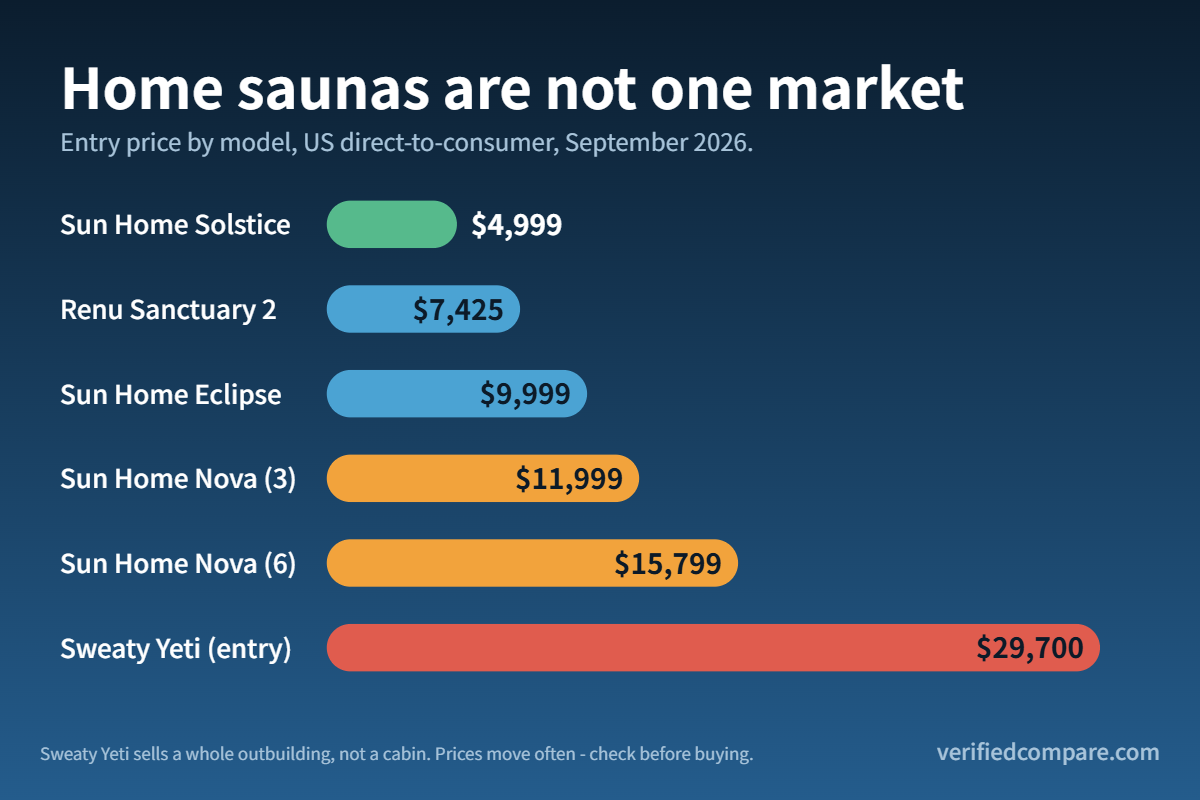
| Brand / model | Type | Price | Capacity | Setting |
|---|---|---|---|---|
| Sun Home Solstice | Far infrared | from $4,999 | 1–4 | Indoor |
| Sun Home Equinox | Full-spectrum infrared | from $6,099 | 2–3 | Indoor |
| Sun Home Pod | Far infrared | from $6,599 | 1 | Indoor |
| Sun Home Eclipse | Full-spectrum + red light | from $9,999 | 2–4 | Indoor |
| Sun Home Luminar | Full-spectrum infrared | from $10,999 | 2–5 | Outdoor |
| Sun Home Nova | Traditional | from $11,999 | 3 | Indoor |
| Sun Home Nova 6 | Traditional | from $15,799 | 6 | Indoor |
| Renu Therapy Sanctuary 2 | Traditional | ~$7,425 | 2 | Indoor |
| Renu Therapy Sanctuary Outdoor 2 | Traditional | ~$8,806 | 2 | Outdoor |
| Plunge — The Sauna / Sauna Mini | Traditional | Discounted, check current | Varies | Both |
| Redwood Outdoors barrel saunas | Traditional | Mid-range | 2–6 | Outdoor |
| Sauna Kit Co bundles | Traditional | $7,000–$10,000 | Varies | Outdoor |
| Sweaty Yeti | Traditional, in an outbuilding | $29,700–$55,200 | 4–6 | Outdoor |
Prices are the manufacturers’ published figures as of September 2026 and reflect discounts that were running at the time. The Sun Home Nova was added to this table in September 2026 after the brand told us it had launched; an earlier version of this guide wrongly described Sun Home as infrared only. This category discounts almost continuously, so treat every number here as a starting point and check before you buy. Where a cell says “not published”, the brand does not list it publicly and we are not going to guess.
Our Picks
Best Range of Price Points — Sun Home
Sun Home is the only brand here that will sell you a sauna at $4,999 and another at $13,899, and the ladder in between is unusually well spaced. The Solstice is the entry, the Equinox adds full-spectrum, the Eclipse adds integrated red light therapy, and the Luminar is the outdoor option. All infrared.
Full-spectrum versus far infrared is worth understanding before you pay the difference: far infrared emits in one band, full-spectrum covers near, mid and far. Whether that is worth $1,100 to you is a judgement we cannot make for you, and the marketing on this point across the whole industry runs well ahead of the evidence.
Good: genuine entry-level option; a clear upgrade path; indoor-friendly; the only brand here offering our readers a discount.
Less good: the infrared range is the bulk of what they sell, and full-spectrum versus far infrared is where the marketing runs furthest ahead of the evidence. The near-permanent sale pricing makes the list prices hard to read at face value. Larger models and the Nova will need 240V — check the specification for the exact unit, not the range.
Check current Sun Home pricing →
Traditional Heat From Sun Home — the Nova
Correction, September 2026: an earlier version of this guide said Sun Home sold infrared only, and that anyone wanting traditional heat should look elsewhere. That was wrong. Sun Home told us directly that they have released the Nova, a traditional sauna, with an outdoor model due in the first quarter of 2027. We are noting the change rather than quietly editing it, because the previous version sent readers who wanted traditional heat to other brands on a false premise.
The Nova is indoor traditional: $11,999 for the 3-person and $15,799 for the 6-person at the time of writing, cedar, a 6kW HUUM heater, and up to 230°F. Sun Home confirmed to us that you can run it dry or pour water on the stones for löyly — which is the question most people buying traditional heat actually care about. That puts it against the Renu Sanctuary below rather than against Sun Home’s own infrared range, and it is a genuinely different purchase from an Eclipse or a Luminar.
We go through the Nova in detail — installation, total cost, and what we do not know yet — in our Sun Home Nova review.
Good: real traditional heat with löyly from the brand with the widest price ladder here; 230°F is properly hot, not a compromise; one company if you also want a cold plunge from them; Sun Home confirmed the $200 reader code applies to the Nova.
Less good: indoor only until the outdoor model lands, which Sun Home puts at Q1 2027, so if you want it in the garden you are waiting. It needs a 240V hardwired circuit — get an electrician’s quote before you order. And it is new, so there is not yet the body of independent owner reports we would normally want before recommending something at this price.
Check current Sun Home pricing →
Best if You Want a Real Finnish Sauna Indoors — Renu Therapy Sanctuary
Traditional heat, built in California, and finished to sit inside a house rather than at the bottom of the garden. The Sanctuary 2 is around $7,425 indoors and the Outdoor 2 around $8,806. Renu builds cold plunges as well, which matters if contrast therapy is the actual goal.
Good: traditional heat with water on rocks; finishes that suit a house; one supplier if you want a plunge too.
Less good: two-person capacity at that price is not generous; traditional means 240V hardwired, so add the electrician to the budget; heavily marketed on celebrity association, which tells you nothing.
Best Known Name — Plunge
Plunge came from the cold side and added saunas, and their contrast bundles are the obvious buy if you want both from one company with one delivery. The Sauna Mini is the small-space option.
Good: contrast bundles; large owner community; a company that will still be there for warranty claims.
Less good: newer to saunas than to plunges; you are paying something for the name; pricing moves constantly with promotions.
Best for a Garden — Redwood Outdoors
Barrel saunas are where Redwood’s reputation was built and they remain well reviewed on build quality. A barrel in a garden is also the cheapest route to a genuine traditional sauna experience.
Good: well-regarded build; the classic outdoor form; sensible if you are buying a cold plunge from them too.
Less good: we could find no contact form or support email on their site, only a phone number, which is worth knowing before spending thousands. Outdoor barrels need a level pad and weatherproofed power.
Best Handcrafted Build — Sweaty Yeti
Sweaty Yeti build traditional saunas by hand in Spanish Fork, Utah, and sell direct rather than through dealers. If you want real Finnish heat and it matters to you that a person made the thing rather than a production line, this is the brand on this page that leans hardest into that.
This is not the same kind of purchase as everything else on this page, and the prices make that obvious. The entry model is $29,700 and the range runs to $55,200. You are not buying a cabin that goes in a spare room — you are buying a finished outbuilding, 4 to 6 person, with the sauna and a cold plunge built in, and you configure the roof, the siding and the doors like you would a garden room.
Against a Sun Home Luminar at $10,999 or a Renu Sanctuary Outdoor at around $8,806, that is three to six times the money. It buys a different thing. Whether it is the right thing depends entirely on whether you want a sauna or a building.
Good: handcrafted traditional construction with hot and cold in one structure; prices published openly, which is rarer at this end of the market than it should be; extensively configurable; direct from the maker, so the person answering the phone knows the product; financing offered.
Less good: the price. $29,700 is roughly what a whole garden room costs, and it is six times a capable outdoor sauna. Options add up fast — metal siding is $925, cedar $1,800. Traditional heat means 240V hardwired, so add the electrician. It needs a prepared pad and real groundwork, not a patio slab. And they are a much smaller company than Plunge or Sun Home, which cuts both ways.
Reader discount: code VERIFIEDCOMPARE5 takes 5% off at Sweaty Yeti — about $1,485 on the $29,700 entry model, and more on the larger builds. Sweaty Yeti confirmed the terms to us directly: no expiry date, no minimum order, and it works on sale-priced models. It cannot be combined with any other promotion, so if they are running a separate offer, check which saves you more.
What the 5% is worth on every model: Sweaty Yeti coupon code, terms confirmed.
Best for a Complete Wellness Room — Sauna Kit Co
Bundles in the $7,000 to $10,000 range pairing a sauna with a cold plunge. One supplier, one delivery, one company to call.
Good: hot and cold from one place; bundle pricing beats buying separately.
Less good: you accept their choice on both halves, and neither component is best-in-class.
Buying Infrared? Ask These Two Questions
Infrared saunas have two quality problems that do not show up in photographs, and both are worth an email to the seller before you buy.
1. EMF, and whether it has been independently tested. Infrared heaters produce electromagnetic fields, and output varies a lot between cheap and well-built units. Reputable brands publish third-party EMF test reports. Ask for the report rather than accepting “low EMF” on a product page — the phrase has no agreed definition.
2. What the cabin is made of and glued with. You are going to sit in a sealed wooden box at 140°F breathing whatever it emits. Plywood, particleboard and the adhesives holding them can off-gas. Ask what the wood is, what the glue is, and whether there is any VOC testing. Solid wood with low-VOC or no adhesive in the panels is what you want.
These two questions separate the market more reliably than price does.
What We Looked At and Did Not Recommend
- Sub-$2,000 infrared cabins from marketplace sellers. Plenty of them. No EMF testing published, no material disclosure, and no company likely to honour a warranty. This is the one category where we would say the cheap option is a genuinely bad idea.
- Infrared blankets and portable sauna tents. Much cheaper and they do produce heat, but the experience is not comparable and neither is the research. Fine as a trial, not a substitute.
- Wood-fired saunas. The best traditional experience for many people, and outside the scope of this guide — they involve planning permission questions, chimney clearances and fire safety that deserve their own article.
- DIY sauna kits for a spare room. Cheapest route to traditional heat if you are competent, but the vapour barrier and ventilation details are unforgiving and a mistake rots the structure.
Which One Should You Choose?
- You want it indoors, in a spare room, without building work: Sun Home infrared. Start with the Solstice unless you specifically want full-spectrum.
- You want the sauna you remember from a spa: traditional. Sun Home Nova or Renu Therapy indoors, Redwood Outdoors in the garden.
- You want hot and cold: Plunge contrast bundles, or Sauna Kit Co.
- You are on a tight budget: Sun Home Solstice at $4,999, or a Redwood barrel. Avoid the sub-$2,000 marketplace cabins.
- You are tall, or want to lie down: check interior dimensions rather than the person count. “Two person” often means two people sitting upright, closely.
- Whatever you pick: get an electrician’s quote before you order.
What We Earn, and What We Do Not
The Sun Home and Sweaty Yeti links on this page are affiliate links. If you buy through one we are paid a commission and you pay the same price. Renu Therapy, Plunge, Redwood Outdoors and Sauna Kit Co pay us nothing, and we recommend them where they fit better — for an outdoor traditional sauna today, Sun Home cannot serve you and they can. They are named here because they are the right answer for particular buyers, and we would rather lose the sale than pretend otherwise.
We will update this page if that changes.
FAQ
Infrared or traditional — which is better?
Neither. They are different products. Traditional gives you high heat and steam from water on rocks; infrared gives you gentler radiant heat and installs far more easily indoors. If you have enjoyed a sauna before, it was almost certainly traditional.
Do I need an electrician?
For most traditional saunas and larger infrared cabins, yes — they need a 240V hardwired circuit. Some smaller infrared models run on a dedicated 120V outlet. Check the specification for the exact model and get a quote before ordering.
What does a home sauna cost to run?
It depends on heater wattage, how long you run it and your electricity rate. A traditional heater draws considerably more than an infrared cabin but runs for a shorter session. Ask the manufacturer for the heater’s rated power and work it out against your own tariff rather than trusting a generic figure.
Can I put a sauna in a garage?
Commonly yes, and it is often the easiest location: concrete floor, power usually nearby, and nobody minds the noise of the fan. Check ceiling height and clearances around the cabin.
How long does assembly take?
Indoor infrared cabins are typically clip-together panels and quoted at one to two hours with two people. Outdoor traditional saunas need a level pad prepared first and take considerably longer.
Is “low EMF” a meaningful claim?
Not on its own — there is no agreed threshold behind the phrase. Ask for the third-party test report. Brands that have one will send it.
Does the $200 reader code work on saunas?
Yes. Code VERIFIEDCOMPARE applies to Sun Home orders of $4,000 or more, and every Sun Home sauna is above that. It does not apply below $4,000.
Save This for Later

Related Guides
- Best Cold Plunge Tubs for Home Use (2026) — the cold half of contrast therapy
- 8 Cold Plunge Brands Compared — several of the same brands, on the cold side
- Placement and Setup Guide — power, drainage and floor loading
- Cold Plunge vs Ice Bath
- Sauna or Cold Plunge: Which Should You Buy First? — buy what your climate cannot give you free
- Sun Home Nova Review — the new traditional sauna, specs confirmed with Sun Home
- Sun Home Promo Code — $200 off, what qualifies