This post contains affiliate links. We may earn a commission if you purchase through a link at no extra cost to you. This article was researched and drafted with AI assistance and reviewed by a human editor before publication.
Not sure which type of setup fits your home? Try our 5-question Cold Plunge Finder first — it checks floor, frequency, budget, renting and power before any brand.
Yes, you can cold plunge in a rental. Most renters who get it wrong do not get it wrong on the tub. They get it wrong on one of four things the product page never mentions: what the lease says about water-filled furniture, what the floor under the tub was built to carry, which circuit the chiller ends up on, and where 100-plus gallons of water goes when it comes out.
This page works through those four in order, with the actual weights of the portable plunges renters buy, and ends with a short email you can send your landlord.
The Short Answer
| Your situation | What works | What to check first |
|---|---|---|
| Just want to try it | Ice in the bathtub you already have | Nothing. The floor is built for a full tub |
| Ground floor, garage or patio | Portable inflatable plunge with a chiller | Lease wording, and which circuit you can use |
| Upper floor, indoors | Bathtub, or a small tub only after asking the building | Floor load — ask management, not the internet |
| Balcony | Nothing filled and permanent | Assume no unless the building says yes in writing |
If you are on the ground floor or have a garage and plan to plunge three or more times a week, a portable plunge with its own chiller is the realistic renter setup. Sun Home’s Performance Series is the one we link to below: it inflates, packs into a carrying case, and plugs into a standard wall outlet.
See the Sun Home Cold Plunge Vertical ($3,799) →
1. Read the Lease Before You Read Reviews
Almost no lease mentions cold plunges. Many mention the thing a cold plunge legally resembles: water-filled furniture. Search your lease for these words:
- “Waterbed”, “water-filled” or “liquid-filled furniture” — the closest existing rule. If it is banned or needs consent, assume a plunge does too.
- “Alterations” or “improvements” — matters if you would need a new outlet or circuit.
- “Appliances” — some leases restrict adding large appliances, and a chiller is one.
- Insurance requirements — some leases require renters insurance with a minimum liability limit.
The waterbed comparison is not a stretch. California, for example, has a specific law for it: a landlord cannot refuse a tenant solely for having a waterbed in a building certified after 1973, provided the tenant carries at least $100,000 of waterbed property-damage insurance, installs it to the manufacturer’s standard, and gives 24 hours’ written notice before installing or moving it (Cal. Civ. Code § 1940.5). That law covers waterbeds, not cold plunges, and we are not suggesting it protects you. It is useful because it shows what a landlord will reasonably worry about — water damage and who pays for it — and it gives you a template for answering that worry before it is raised.
Ask in writing, even if the lease is silent. Silence is not permission, and “I asked and you said yes” is a much better position than “nobody told me not to” if water ever reaches the unit below. A copy-and-paste email is at the end of this page.
2. The Floor: What a Portable Plunge Actually Weighs
Water weighs 8.34 lb per US gallon. Portable plunges are light to carry and heavy to fill. Here are the two Sun Home Performance models, using Sun Home’s published capacity and dimensions, plus one 180 lb adult.
| Setup | Water | Filled, with one adult | Footprint | Load on that footprint |
|---|---|---|---|---|
| Standard bathtub, filled to plunge | ~40–50 gal | ~550–600 lb | Already designed for | Not your problem |
| Sun Home Vertical (106 gal) | 884 lb | ~1,080 lb | 35.4 × 35.4 in (8.7 sq ft) | ~124 lb/sq ft |
| Sun Home Horizontal (128 gal) | 1,068 lb | ~1,263 lb | 77.2 × 27.6 in (14.8 sq ft) | ~85 lb/sq ft |
Both tubs weigh 15.5 lb empty; the chiller is a separate 88 lb unit that sits beside the tub. Sun Home’s published figures, September 2026.
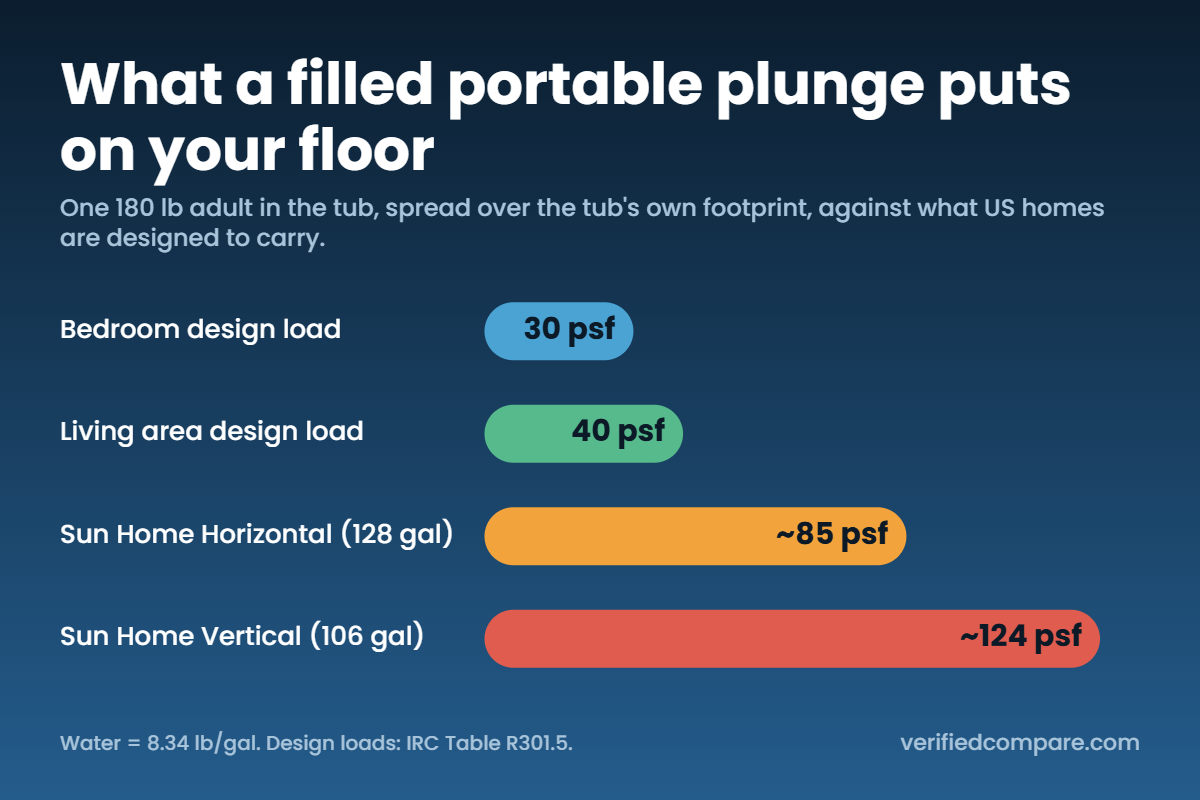
For scale: US homes are commonly designed for a live load of 40 lb per square foot in living areas and 30 in bedrooms (IRC Table R301.5). Both plunges put two to three times that on the patch of floor under them.
Two things follow from the table that most renter guides miss:
- The bigger tub is gentler on the floor. The Horizontal holds more water but spreads it over 70% more floor, so it loads each square foot about a third less than the Vertical. If floor load is your concern, the compact-looking option is the harder one on your joists.
- A design load is not a failure point. Floors carry a safety factor and spread load across joists, so exceeding 40 psf on one patch does not mean the floor fails. It means this is a question for the building, not for a product page — and on an upper floor, “the building” is who you need a yes from anyway.
Where the load question disappears: a ground floor on a concrete slab, a garage, or a patio at ground level. If you have any of those, you are in the easy group. Where to assume no: balconies. Even where a balcony is rated similarly to a floor, a filled plunge is a permanent concentrated load at the edge of the structure, and many buildings and HOAs prohibit it outright.
3. Power: “Standard Plug” Does Not Mean “Any Outlet”
This is where renters get caught out most, because the headline spec sounds like good news. Sun Home’s Performance plunges use a standard NEMA 5-15 wall plug at 120V — no 240V hardwiring, no electrician to install the plunge itself. But the same spec sheet says that outlet must sit on a dedicated 15 amp GFCI circuit.
In a house you own, that is a quick electrician job. In a rental, adding a circuit is an alteration you need the landlord to agree to and usually arrange. So before you order:
- Find out what else is on the circuit. Look at the breaker panel labels, or switch a breaker off and see what goes dark. A garage circuit shared with a freezer or a washer is exactly the situation a dedicated-circuit requirement exists to avoid.
- Check for GFCI protection. Garages, patios and bathrooms often already have GFCI outlets. If the outlet you want to use does not, that is a conversation with the landlord, not a workaround.
- No extension cords. A chiller is a continuous load near water. If the outlet is not where the plunge can go, the plunge goes somewhere else.
- If the answer is “no dedicated circuit available”, that is a real reason to stay with ice for now rather than to plug in and hope.
Sun Home also specifies that the chiller needs ambient air above 40°F and a spot at least five feet from other appliances, and it pushes heat out of the fan side. In a small room that is warmth you will notice; against a shared wall it is a hum your neighbour may notice too.
4. Water In, Water Out, and Who Pays If It Escapes
Filling is easy — a hose from a laundry tap, an outdoor spigot, or a faucet adapter on a sink. Emptying is the recurring job. With filtration and ozone, Sun Home suggests changing the water every two to three weeks, which means moving 106 to 128 gallons each time.
- Plan the drain route before you buy. A shower, a bathtub, a floor drain, or outside. Measure the hose run and buy one that reaches with slack.
- Budget for a small submersible pump. They cost well under $100 and turn a slow gravity drain into a few minutes.
- Put a waterproof mat or catch tray down before the first fill. Drips from getting in and out add up, and condensation forms on anything cold in a warm room.
- Call your renters insurer. Ask one specific question: does my personal liability cover accidental water damage to the building or to the unit below? Policies differ, and it is a two-minute call that is much cheaper than finding out afterwards.
Your Options, Compared
| Option | Price | Cooling | Floor question | Moves with you | Best for |
|---|---|---|---|---|---|
| Ice in your own bathtub | $0 + ice | Bagged ice every session | None | Nothing to move | Trying it before spending anything |
| Inflatable, no chiller | $150–$600 | Bagged ice every session | Small | Folds flat | A few sessions a week, tight budget |
| Inflatable with chiller (Nordic Wave Voyager and similar) | from $1,190 | Chiller | Moderate | Tub folds; chiller carries | Regular plunging on a budget |
| Sun Home Vertical | $3,799 | 1HP chiller, to 32°F | ~124 psf — ground level | Tub packs in a case; chiller 88 lb | Small footprint, seated plunge |
| Sun Home Horizontal | $3,999 | 1HP chiller, to 32°F | ~85 psf — ground level | Tub packs in a case; chiller 88 lb | Full recline; lighter on the floor |
| Rigid or cabinet tubs | $5,000+ | Built-in chiller | Heavy, fixed | Needs a crew | Owners, not renters |
Sun Home prices are their sale prices as published in September 2026. We do not earn anything from Nordic Wave.
Ice versus a chiller is a frequency question. At two to three bags of ice a session and about $4 a bag, four plunges a week costs $1,664 to $2,496 a year in ice. Below about three sessions a week, ice wins; above it, a chiller pays for itself. The full arithmetic is in our cold plunge vs ice bath comparison.
Why a Portable Plunge Suits Renting
The case for the portable category is not that it is cheaper — a chiller-equipped portable is not cheap. It is that it leaves when you do. Sun Home’s Performance tubs are drop-stitch inflatables that ship with an insulated cover, a carrying case and a repair kit, and the chiller is a separate unit. Nothing is plumbed in, nothing is fixed to the building, and move-out day is drain, deflate, pack.
Good: standard plug; chiller cools to 32°F and can also warm the water to 104°F; ozone sanitation and two-stage filtration, so water changes are every few weeks rather than every few sessions; app control; comes with you when you move.
Less good: the dedicated-circuit requirement is a real hurdle in many rentals; a filled tub still needs a ground-level floor; an inflatable wall flexes more than a rigid tub; the chiller will not run below 40°F ambient, so an unheated winter garage is out; and Sun Home lists the warranty as “1+ year”, so check the exact terms on the product page before you order.
See the Sun Home Cold Plunge Horizontal ($3,999) →
About the discount code. Sun Home’s code VERIFIEDCOMPARE takes $200 off orders of $4,000 or more. At current sale prices the Vertical ($3,799) and Horizontal ($3,999) sit just under that on their own, so the code only helps if the order includes something else you actually wanted. Details on our Sun Home promo code page.
A Landlord Email You Can Copy
Short, specific, and it answers the three questions a landlord will have before they ask them: how heavy, what power, and what if it leaks.
Hi [name],
I’d like to set up a portable cold plunge tub in [the garage / ground-floor room / patio] and wanted to check with you first.
It’s a freestanding inflatable tub, about [35 x 35 in / 77 x 28 in], holding [106 / 128] gallons — roughly [1,080 / 1,260] lb when filled and in use. Nothing is plumbed in or fixed to the building, and it drains and packs away completely.
It plugs into a standard 120V outlet, and the manufacturer asks for a dedicated 15 amp GFCI circuit. [The outlet at ___ appears to be on its own circuit / Could we discuss whether that’s possible?]
I’ll use a waterproof mat underneath, drain it to [the shower / outside] with a pump, and I’ve confirmed my renters insurance covers accidental water damage [or: I’m happy to add coverage if you’d like].
Is that OK with you? Happy to send the spec sheet.
Thanks, [your name]
FAQ
Can my landlord say no to a cold plunge?
Generally, yes, if the lease restricts water-filled furniture, alterations or appliances, or if the building says the floor cannot take it. Rules vary by state and by lease. That is why asking in writing first matters.
Can I put a cold plunge on my apartment balcony?
Assume not, unless building management confirms it in writing. A filled portable plunge with someone in it is over 1,000 lb concentrated on a few square feet.
Does a plug-in cold plunge need its own circuit?
Check the model’s spec sheet. Sun Home’s Performance plunges use a standard plug but specify a dedicated 15 amp GFCI circuit. Do not substitute an extension cord.
Is a cold plunge safe on an upper floor?
Sometimes, but not on the basis of a product page. Ask building management or have a structural engineer look. A bathtub with ice avoids the question entirely.
What happens when I move?
With a portable plunge: drain it, let it dry, deflate it into its case, and move the chiller like any other small appliance. With a rigid tub: you are hiring movers.
Will renters insurance cover a leak?
It depends on your policy. Ask your insurer directly whether personal liability covers accidental water damage to the building or neighbours.
Is a cold plunge safe for everyone?
No. Cold water immersion is a real stress on the heart and circulation. If you have a heart condition, high blood pressure or are pregnant, talk to a doctor first, and never plunge alone or after drinking.
Save This for Later

Related Guides
- Cold Plunge Placement & Setup Guide — garage, basement, patio and deck
- Budget Cold Plunge Tubs Under $1,000 — and the ice arithmetic
- Cold Plunge vs Ice Bath — chiller or ice
- Best Cold Plunge Tubs for Home Use (2026) — model by model
- 8 Cold Plunge Brands Compared — who each brand suits
- Sun Home Promo Code — $200 off, what qualifies