
This post contains affiliate links. We may earn a commission if you purchase through a link at no extra cost to you. This article was researched and drafted with AI assistance and reviewed by a human editor before publication.
Not sure which type of setup fits your home? Try our 5-question Cold Plunge Finder first — it checks floor, frequency, budget, renting and power before any brand.
“Cold plunge” and “ice bath” get used interchangeably online, but they are not the same purchase. One is a machine that keeps water cold. The other is a container you put ice into. The water can end up at the same temperature either way — what differs is what it costs you, in money and in the effort it takes to keep doing it.
This guide is about which one you should buy. If you have already decided you want a chiller, our main cold plunge roundup compares specific models.
The Short Answer
Under three sessions a week, buy ice. Three or more, buy a chiller. That threshold is not a preference, it is arithmetic, and the working is below.
Already know you are in the second group? Sun Home is the brand we have vetted most closely, from $3,999, and the only one giving our readers a discount. Check current pricing — or read on for the working.
Comparison Table
| Cold plunge (chiller) | Ice bath (manual ice) | |
|---|---|---|
| Upfront cost | $2,000–$14,000 | $150–$1,200 |
| Ongoing cost | Electricity, roughly $15–$40/month | Ice, $8–$12 per session |
| Ready when you are | Always | After a supermarket trip |
| Temperature control | Set and held | Drifts upward from the moment you get in |
| Water changes | Every few weeks with filtration | Every few sessions |
| Setup needed | Power, drainage, floor loading | Somewhere to put a tub |
| Suits | 3+ sessions a week | 1–2 sessions a week |
The Break-Even Calculation
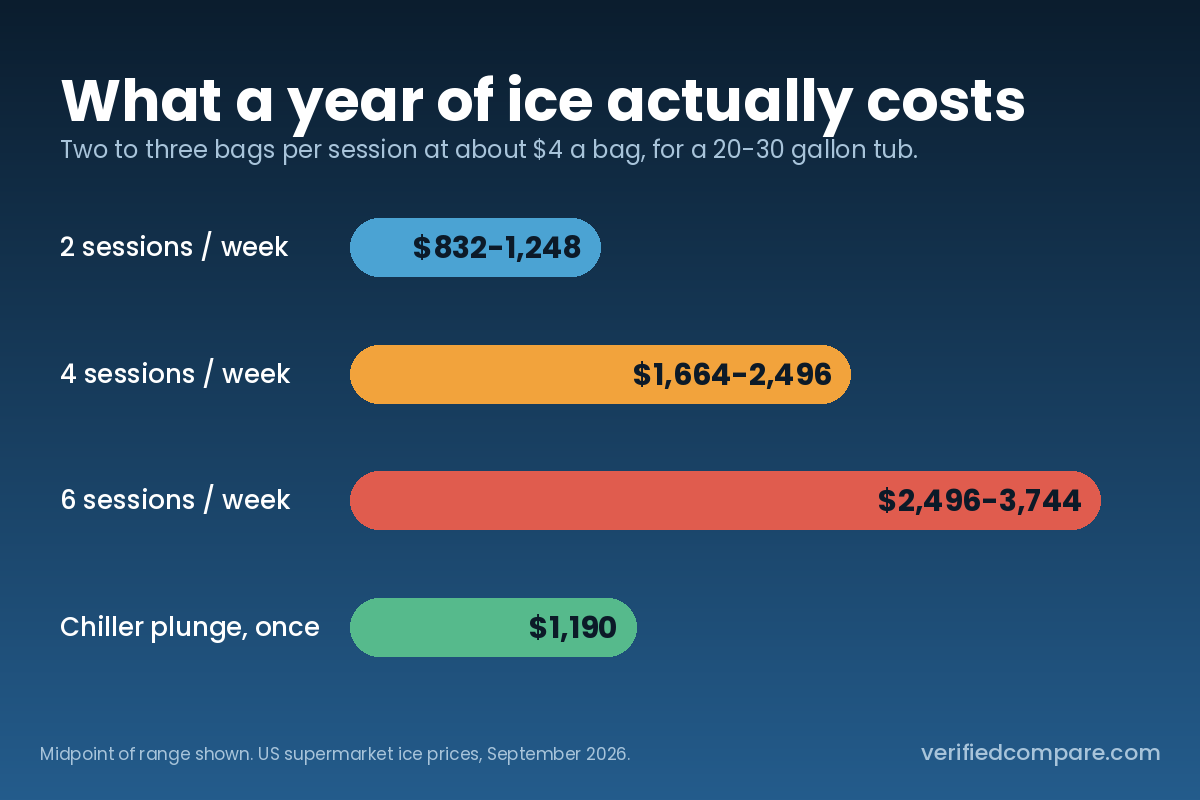
Bringing a 20 to 30 gallon tub to plunge temperature takes two to three bags of ice. At around $4 a bag that is $8 to $12 a session, every session, forever.
| Sessions/week | Ice per year | Years to reach $5,000 (mid-range chiller tub) |
|---|---|---|
| 2 | $832–$1,248 | 4–6 years |
| 4 | $1,664–$2,496 | 2–3 years |
| 6 | $2,496–$3,744 | Under 2 years |
At six sessions a week a mid-range chiller tub pays for itself in under two years, and a $1,190 inflatable with a chiller pays for itself in about four months. At two sessions a week it takes half a decade, by which time the chiller is out of warranty.
The honest caveat: most people who buy a plunge do not sustain six sessions a week. Be realistic about the number you will actually hit in February, not the one you are hitting in the first excited fortnight.
What the Table Does Not Capture
Consistency is the real difference
People stop cold plunging because of the ice run, not because of the cold. Every session that requires a trip to a shop is a session with a reason to skip. A chiller removes the decision — the water is already at 48°F whether you feel like it or not. If you know yourself to be someone who needs friction removed, that is worth more than the arithmetic says.
Cold is cold, but stability is not
Physiologically the two are equivalent at the same temperature. What differs is what happens over the session. An ice bath starts at its coldest and warms from the moment your body enters it, so the last minute is meaningfully warmer than the first. A chiller holds the set point. If you are following a protocol that specifies a temperature and a duration, only one of these actually delivers it.
Water hygiene
A chiller tub with filtration and ozone or UV holds water for weeks. An ice bath has no filtration, so you are draining and refilling every few sessions — and if you do not, you are getting into water that has had several people’s skin in it. This is the part owners underestimate.
Where it can live
An ice bath needs floor space and nothing else. A chiller tub needs a power outlet, somewhere for the heat and noise the chiller produces, a drainage plan, and a floor that can take several hundred kilograms when filled. Our placement and setup guide covers what to check before ordering.
Before You Buy Either: Safety
Cold water immersion is not risk-free, and this is worth a paragraph rather than a footnote.
- Cold shock is the immediate risk. Sudden immersion triggers an involuntary gasp and a spike in heart rate and blood pressure. Enter slowly and keep your head out until your breathing settles.
- It puts load on the cardiovascular system. If you have a heart condition, high blood pressure, are pregnant, or have Raynaud’s or a circulatory disorder, talk to a doctor before starting. This applies equally to a $150 inflatable and a $14,000 tub.
- Do not plunge alone when starting out, and never after drinking.
- Afterdrop is real. Core temperature keeps falling for a while after you get out. Warm up gradually rather than jumping into a hot shower.
We are a product comparison site, not a medical one. The above is general safety information, not advice about your situation.
Which One Should You Choose?
- You have never done this: ice bath, cheapest one you can find. Find out whether you will keep it up before spending money on a machine.
- One or two sessions a week, and you are fine with the ritual: ice bath. The arithmetic does not justify a chiller and some people genuinely enjoy the preparation.
- Three or more sessions a week: chiller. You are already spending chiller money on ice.
- You follow a specific temperature protocol: chiller. An ice bath cannot hold a set point.
- Apartment, no drainage, no outdoor space: ice bath, or an inflatable with a built-in chiller from around $1,190.
- You keep skipping sessions: chiller. The friction is the problem, not your discipline.
FAQ
Is an ice bath as effective as a chiller-cooled plunge?
At the same water temperature, yes. The difference is that an ice bath does not stay at that temperature and a chiller does.
Can I add a chiller to a basic ice bath tub later?
Often, yes, and it is a sensible upgrade path. Standalone chillers start around $3,990 from well-known brands. Two things to check: that the tub is insulated, because running a chiller against an uninsulated tub wastes most of its output, and that the tub has ports or a route for the hoses.
How cold does the water need to be?
50–59°F is a normal starting range. Experienced users often go to 39–50°F. Colder is not automatically better and it is harder to sustain, which matters more.
How much electricity does a chiller use?
Expect roughly $15 to $40 a month depending on ambient temperature, insulation and set point. A tub in a hot garage in August costs considerably more to hold than the same tub in a cool basement.
Can I just use a chest freezer?
People do. We do not recommend it: you are putting water into an appliance not designed for it and then standing in it. The electrical risk is not theoretical.
Do cold showers count?
As a starting point, they are fine and they are free. They are not equivalent — you cannot get your torso submerged, and submersion is most of the effect.
If You Landed on “Buy a Chiller”
Three sessions a week is the line. Above it, the ice is already costing you what a machine costs, and the machine removes the reason people quit.
Sun Home is the brand we have vetted most closely and the only one offering our readers a discount: entry at $3,999, top of the range $13,999, with code VERIFIEDCOMPARE taking $200 off orders of $4,000 or more.
Which models qualify, how it stacks with Sun Home’s sales, and the one cold plunge that falls $1 short: Sun Home promo code, conditions confirmed.
Check current Sun Home pricing →
If you landed on “buy ice” instead, our budget guide covers that tier and we earn nothing from it.
Save This for Later

Related Guides
- Best Cold Plunge Tubs for Home Use (2026) — the chiller-equipped models
- Budget Cold Plunge Tubs Under $1,000 — the ice bath end of the market
- 8 Cold Plunge Brands Compared — who each brand is aimed at
- Placement and Setup Guide — power, drainage and floor loading
- Best Home Saunas (2026) — infrared vs traditional, and the electrical question
- Sauna or Cold Plunge: Which Should You Buy First? — buy what your climate cannot give you free
- Sun Home Nova Review — the new traditional sauna, specs confirmed with Sun Home
- Sun Home Promo Code — $200 off, what qualifies