
This post contains affiliate links. We may earn a commission if you purchase through a link at no extra cost to you. This article was researched and drafted with AI assistance and reviewed by a human editor before publication.
Most people who get interested in contrast therapy want both, and cannot buy both at once. This is about which one to buy first — and the answer depends far less on which you prefer than on where you live and what your house can take.
The Short Answer
Buy the sauna first if you live somewhere cold. Buy the plunge first if you live somewhere hot.
It sounds like a joke and it is not. In a cold climate, the outdoor air does half the plunge’s job for months at a time — you can get cold water almost free in winter, whereas heat is something you have to generate. In a hot climate the reverse: a chiller fighting a 95°F garage is working constantly, but you can get hot almost anywhere.
Buy the thing your environment cannot give you. Everything below is the detail behind that.
Cost to Buy, and Cost to Run
| Cold plunge | Sauna | |
|---|---|---|
| Realistic entry | $1,190 inflatable with chiller | $4,999 infrared cabin |
| Mid-range | $4,000–$10,000 | $6,000–$11,000 |
| Cheapest way in at all | $150 tub plus bags of ice | No real equivalent |
| Running cost | Chiller runs continuously | Heater runs only in use |
| Electrical work | Often a standard outlet | Often 240V hardwired |
| Water and maintenance | Filtration, draining, refills | Essentially none |
| Session length | 2–5 minutes | 15–45 minutes |
| Space needed | Small footprint, heavy when filled | Larger footprint, light |
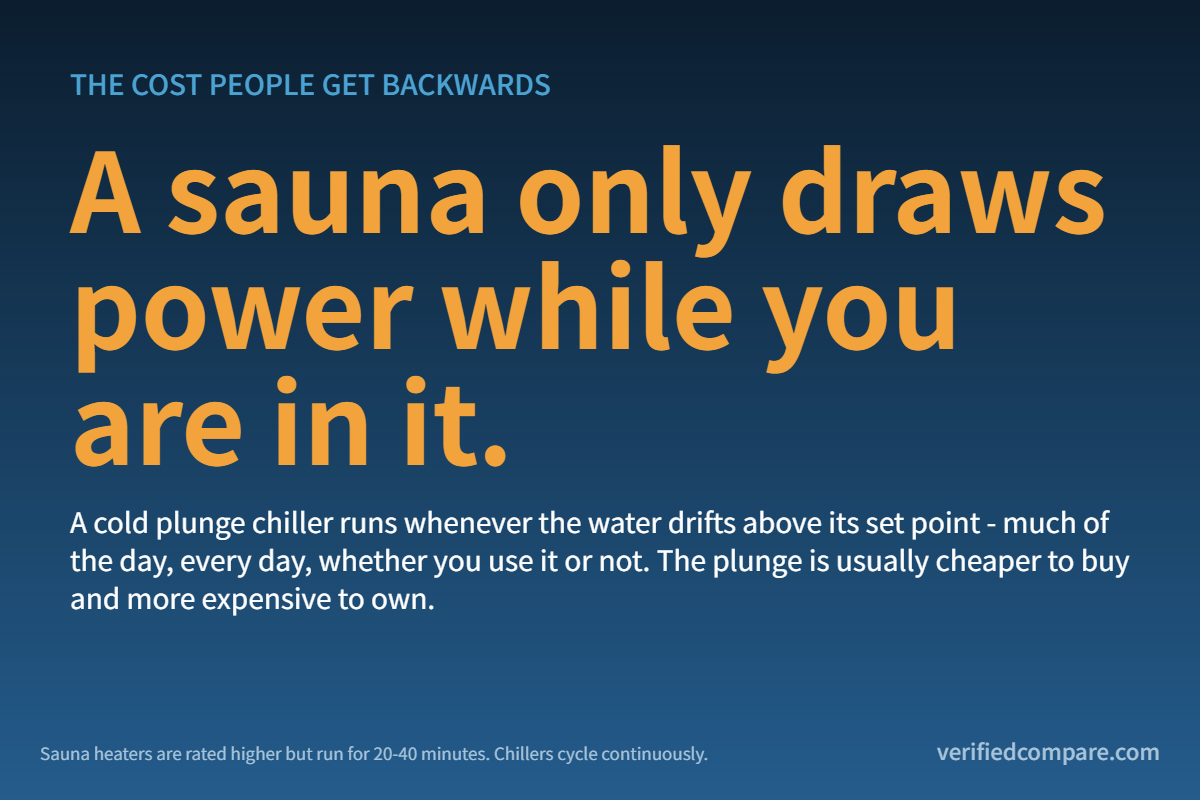
The running-cost difference is the one people get backwards. A sauna only uses power while you are in it. A cold plunge chiller runs whenever the water drifts above its set point, which in a warm room is much of the day, every day, whether you use it or not. Over a year the plunge is usually the more expensive machine to own even though it can be the cheaper one to buy.
The reverse applies to installation. Many infrared saunas and almost all traditional heaters need a 240V circuit and an electrician; plenty of plunges run from a normal outlet. Ask both questions before you compare the sticker prices.
How We Picked the Criteria
We do not own either of these and we have not run them for a year. We are not going to tell you how a session felt. What this article does is line up the practical constraints — power, space, climate, maintenance, time — because those are what actually decide which one you will still be using in six months.
We deliberately left the health comparison out of the ranking. That is not our field, the evidence for each is at a different stage of maturity, and a product comparison site is not where you should be settling that question.
Buy the Sauna First If…
- You have real winters. Outdoor water in a cold climate gets genuinely cold for free. Heat does not arrive on its own.
- You want the longer session. Sauna is 20 to 40 minutes of sitting. Plunge is three minutes of unpleasantness. Which of those you will actually do on a bad day is worth being honest about.
- You want it indoors with no water plumbing. An infrared cabin in a spare room needs power and floor space. No drain, no refills, no water chemistry.
- Maintenance puts you off. A sauna needs sweeping. A plunge needs filtration, water changes and monitoring.
- Other people in the house might use it. Saunas get shared. Cold plunges, in our reading of owner reports, mostly do not.
Buy the Cold Plunge First If…
- You live somewhere hot. Cold is the thing you cannot get for free, and a plunge is usable year round where a sauna in a hot climate becomes a summer-free zone.
- You have very little time. Three minutes versus forty. For a lot of people this is the whole argument.
- Your budget is genuinely tight. You can start cold for $150 and a bag of ice. There is no $150 sauna — the cheap end of that market is the one part of this whole category we would tell you to avoid.
- You cannot get 240V easily. Plunges more often run on a standard outlet.
- Ceiling height is a problem. Saunas need headroom. Plunges do not.
The Honest Version: Most People Should Start Cheap on One Side
The failure mode in this category is not buying the wrong one. It is spending $9,000 in month one on a habit that had not formed yet, and using it eleven times.
If you have not done either consistently for three months, the sensible path is a $150 tub and bags of ice, or a gym membership with a sauna, and find out which one you actually return to. The equipment question answers itself after that, and you will have spent almost nothing to learn it.
We would rather say that than sell you a tub. Our budget cold plunge guide covers the cheap end honestly, including the point at which the ice bill makes it a false economy.
If You Are Buying Both
Two things are worth knowing.
Bundles are real savings, not just marketing. Plunge and Sauna Kit Co both sell contrast packages, and you save on one delivery, one installation visit and one company to deal with when something goes wrong. Against that, you are accepting their choice on both halves.
One brand can cover both, but check which technology. Sun Home sells cold plunges plus both infrared saunas and, since 2026, a traditional one — the Nova, indoor only for now, with an outdoor model due in Q1 2027. Renu Therapy, Sweaty Yeti, Plunge and Redwood Outdoors sell cold plunges alongside traditional saunas. If you want traditional heat outdoors today, that still rules Sun Home out, whatever the bundle price says.
Our home sauna guide covers the infrared versus traditional question in full, and the brand comparison does the same on the cold side.
Reader Discount: $200 Off Sun Home
Sun Home is our affiliate partner and sells both cold plunges and infrared saunas. Code VERIFIEDCOMPARE takes $200 off any order of $4,000 or more. It is valid for one year and stacks with their site-wide promotions. It does not apply below $4,000, which means it does not apply to the cheapest way into cold water — and if that is the right call for you, take the cheaper route and ignore the code.
Which models qualify, how it stacks with Sun Home’s sales, and the one cold plunge that falls $1 short: Sun Home promo code, conditions confirmed.
Check current Sun Home pricing →
Sun Home and Sweaty Yeti are the only brands mentioned on this page that pay us anything. Plunge, Renu Therapy, Redwood Outdoors, Sauna Kit Co and Nordic Wave pay us nothing, and we still send you to them where they fit better — for an outdoor traditional sauna today, they are the answer and Sun Home is not. An earlier version of this page said Sun Home did not sell traditional saunas at all. That was wrong, and we corrected it in September 2026 after the brand told us about the Nova.
Safety, Briefly
Both put load on the cardiovascular system, and contrast therapy moves you between the two quickly.
- If you have a heart condition, high blood pressure, are pregnant, or have a circulatory disorder, talk to a doctor before starting either.
- Never after drinking, and not alone when you are starting out.
- Cold shock causes an involuntary gasp on immersion. Enter slowly, keep your head out until your breathing settles.
- Sauna dehydrates. Drink before and after, and do not extend sessions to prove something.
- Core temperature keeps falling after a plunge. Warm up gradually rather than straight into a hot shower.
We are a product comparison site, not a medical one. That is general safety information, not advice about your situation.
FAQ
Which is cheaper to own?
The sauna, usually. It is often more expensive to buy but only uses power while you are in it, whereas a plunge chiller runs whenever the water warms up.
Do I need both for contrast therapy?
Not necessarily. A hot shower and a cold tub will give you a temperature swing. Whether the full protocol is worth the second machine is a judgement, and it is one a lot of people make before knowing if they will keep going.
Which order should I do them in?
Protocols vary and people are strongly opinionated about it. Finishing on cold is the more common recommendation. We would not build a purchase decision on it.
Can I put both in a garage?
Often yes, and it is usually the easiest room for either. Check ceiling height for the sauna, floor loading and drainage for the plunge. Our placement guide covers the numbers.
Does the $200 code work on both?
Yes, on Sun Home orders of $4,000 or more, cold plunge or sauna. Not below $4,000.
Save This for Later

Related Guides
- Best Home Saunas (2026) — infrared vs traditional, and the electrical question
- Best Cold Plunge Tubs for Home Use (2026)
- Budget Cold Plunge Tubs Under $1,000 — the cheap way to find out if this sticks
- Cold Plunge vs Ice Bath
- Placement and Setup Guide
- Sun Home Nova Review — the new traditional sauna, specs confirmed with Sun Home
- Sun Home Promo Code — $200 off, what qualifies